Tuesday, March 8, 2016

As I prepare for the Wellie Race, a story about SUGRU....

With only five more sleeps to the St Patrick´s Day Wellie Race up the Alps, I am a bit too busy with wellie race prepping to write a blog posting.  So instead, for you dear blog reader´s edification and pleasure, I am enclosing a excerpt from an article  published in the New York Times on March 2nd last about Sugru.    If you don´t know what Sugru is, you will after you read the article.   

-  And check out the chicken with the foot way down at the end of the article. 

New York Times:
Sugru, a Versatile Glue From Ireland, Gets Help From Web
Photo Jane Ni Dhulchaointigh, inventor of Sugru, with her product at Sugru headquarters in  London.  

Credit Andrew Testa for The New York Times 

 
It can fix a broken statue, repair a frayed iPhone cable, add a rubbery grip to a kitchen knife, make those Bose earbuds fit better, repair a leaky boat — and even create a prosthetic leg for a chicken. So, what is this product?

It is Sugru, and it is being heralded as the product you never knew you needed — until you did.

Sugru is a moldable glue. It looks like Play-Doh, can be shaped around any object, sticks to almost any material, is waterproof, is heat-resistant and dries to a silicone rubbery finish in 24 hours. Its ability to bond to virtually any surface — wood, glass, metals and ceramics among others — and its moldable nature make it unusual in the world of adhesives, sealants and glues.

“I wanted to design something that was so easy and so fun to use that more people would consider fixing things again,” said Jane Ni Dhulchaointigh, the Irish entrepreneur behind Sugru. Even the name is taken from the Irish word “sugradh,” which means “play.”

Bridget Grunst, a buyer for Target Corporation stores, admits she was skeptical before meeting Sugru’s team in the fall of 2014. After all, Target already carried more than 40 glue products in its home improvement section alone.

“Did I roll my eyes? Yes,” she said, laughing. “I mean, glue is not the most innovative category out there.” But all of that changed when Ms. Grunst met the Sugru team and watched in amazement at the myriad ways, both practical and creative, that the glue could be used. The iPhone charger repair was the clincher.

“I have frayed cords at home, and it’s a unique way to fix it versus having to go buy another charger for $50,” Ms. Grunst said.  Sugru’s rubbery flexible finish allowed it to repair charger cords, which superglues, with their rock-hard finishes, cannot do, she said.
That Ms. Ni Dhulchaointigh (pronounced nee-GULL-queen-tigg) would develop a product like Sugru would not have been easy to predict.

Born in Kilkenny, Ireland, in 1979, Ms. Ni Dhulchaointigh grew up on a farm, where her father, John, worked as a farmer, and her mother, Eilis, was a teacher. As a youngster, she had an artistic bent, making paintings and sculptures. She received a degree in fine art from the National College of Art and Design in Dublin in 2001 and a master’s degree in product design from the Royal College of Art in London in 2004.

It was at college where she first started experimenting with clay, silicon sealants and other materials for sculpting. She would bring them home and soon started using them around the house — wrapping the putty around knife handles to get a better grip, using it to fix a leaky kitchen sink stopper, adding it as rubber “feet” to the bottom of a laptop and repairing a mug handle. 

Her boyfriend, James Carrigan, who is now her husband, noticed her clever repairs and suggested she try to market it.

When she showcased the prototype at a student product design exhibition in 2004, the response was overwhelming, she said. “The top two questions were: ‘How much is it’ and ‘Where can I get it?’ ” she said. She knew she had a potential hit..............

It took five years, 5,000 experiments and 8,000 lab hours to perfect and patent the formula.......

In 2009, she took the social media route, sending samples to dozens of technology bloggers, in the belief that if they saw its potential role in repairing information technology equipment, they’d promote it.  


 The strategy worked. “It went viral,” she said. When the company introduced its website in December 2009, all 1,000 packages, which took two months to make by hand, sold out within six hours. An additional 2,000 were sold on back order. “It was incredible; it changed everything.” Photo Credit:  Andrew Testa for The New York Times.

Suddenly, “investors were reading about us all over the Internet, and they started coming to us asking how they could help,” she said. Time magazine listed Sugru, alongside the iPad, as one of the top 50 inventions of 2010.  (note from moi: Sugru came in on the TIMES list 3 places ahead of the Ipod!)

Sales topped $5.5 million in 2015, up from $3.4 million in 2014 and $250,000 in its first year in 2010. Ms. Ni Dhulchaointigh expects sales to exceed $10 million this year and $60 million by 2020.
It is now sold online to more than 160 countries and through 19 brick-and-mortar retailers in 6,050 stores in four countries. In the United States, 10 retailers carry the product in 4,500 stores.

Sugru’s ability to bond to virtually any surface and its moldable nature make it unusual in the world of adhesives, sealants and glues.

Ms. Ni Dhulchaointigh said Sugru could withstand temperatures as high as 356 degrees and as low as minus 58 degrees, making it durable indoors and out. It will not melt, freeze, soften or harden. It can be thrown into a washing machine or dishwasher, and even soaked in seawater.

If a user makes a mistake, a sharp knife can be used to cut through Sugru’s rubbery surface, removing it without damaging the surface of the repaired item. With other two-part hard-core glues, “once you put them on something, you can’t go back. They’re on there forever,” she said.....

A motorcyclist has used Sugru to mount a camera to his helmet, and then went on a ride down the highway filming his journey.

Lauren Richardson, an aerobatic pilot in Britain, used Sugru to strap a camera to the outside of her plane’s wing, so the camera could capture her flips and turns.
“There were some really clever fixes and really wacky ones that made us laugh,” Ms. Ni Dhulchaointigh said.

And then there’s the chicken:

When a fox attacked a pet hen at a family’s home in Cork, Ireland, the hen lost a leg. So, the owner, a retired engineer, built a fiberglass prosthetic leg and used Sugru to add chicken feet to the prosthetic.

The chicken now walks on two feet. Credit via Sugru                             ---------------------------------------------------------
You may think I am enclosing this piece because everyone loves a great story with an ´ahh factor´.  Especially me.  But there is more to the story than that.

And that story is how I found out about SUGRU.

My friend Susan in Canada sent me an e-mail here in Germany with good ways to budget etc.  One tip came from a site called the Everday Cheapskate based in Los Angelos in the U.S.   The Everyday Cheapskate has been telling America on T.V. and in print media how to live cheaply for 20 years.  And the Cheapskate´s plug for the 1st of July 2014 last was SUGRU
   
SUGRU struck me becuse it is the Irish word for ´play´.  I recalled hearing some years earlier in the coming and going of life at home in Kilkenny that one of the Delehantys up the road,  ´had invented a great thing for sticking things together´.
The idea came to me that this might well be the great sticking together product that one of the Delehantys up the road had invented.  
And I was right!  I found the SUGRU website, and could see that the Jane in the video on Sugru was the spit of Mrs. Delehanty up the road.  Jane could have easily been a Delehanty from up the road.  And she was. And so there you are!

See link to more articles on Jane Delehanty and her Sugru below.

- So now go out and buy some and have fun with your Sugru all day! 

P.S. For the alert, confused and frazzeled  Ní  Dhulchaointigh (pronounced nee-GULL-queen-tigg) is the Irish form for the surname Delehanty.

Sunday, February 28, 2016

This will be very interesting for some and not at all for others....

True, this blog posting will, I think, be very interesting for some and not at all for others.  Be warned, it is sad reading.  

My thanks to my friend Sue who posted the article from Canada; the article was taken from the website peoples trust toronto   


Note:  I can find neither the name of the writer of the article nor the artist who painted this picture.  If anyone  knows either, I would be delighted if you could let me know. Thanks.

IRISH: THE FORGOTTEN WHITE SLAVES

https://peoplestrusttoronto.files.wordpress.com/2014/12/9dee9-irish-slaves.jpg


IRISH: THE FORGOTTEN WHITE SLAVES
Source: http://goo.gl/LQ9JTW

They came as slaves: human cargo transported on British ships bound for the Americas. They were shipped by the hundreds of thousands and included men, women, and even the youngest of children.

Whenever they rebelled or even disobeyed an order, they were punished in the harshest ways. Slave owners would hang their human property by their hands and set their hands or feet on fire as one form of punishment. Some were burned alive and had their heads placed on pikes in the marketplace as a warning to other captives.

We don’t really need to go through all of the gory details, do we? We know all too well the atrocities of the African slave trade.

But are we talking about African slavery? King James VI and Charles I also led a continued effort to enslave the Irish. Britain’s Oliver Cromwell furthered this practice of dehumanizing one’s next door neighbour.

The Irish slave trade began when James VI sold 30,000 Irish prisoners as slaves to the New World. His Proclamation of 1625 required Irish political prisoners be sent overseas and sold to English settlers in the West Indies.

By the mid 1600s, the Irish were the main slaves sold to Antigua and Montserrat. At that time, 70% of the total population of Montserrat were Irish slaves.

Ireland quickly became the biggest source of human livestock for English merchants. The majority of the early slaves to the New World were actually white.

From 1641 to 1652, over 500,000 Irish were killed by the English and another 300,000 were sold as slaves. Ireland’s population fell from about 1,500,000 to 600,000 in one single decade.

Families were ripped apart as the British did not allow Irish dads to take their wives and children with them across the Atlantic. This led to a helpless population of homeless women and children. Britain’s solution was to auction them off as well.

During the 1650s, over 100,000 Irish children between the ages of 10 and 14 were taken from their parents and sold as slaves in the West Indies, Virginia and New England. In this decade, 52,000 Irish (mostly women and children) were sold to Barbados and Virginia.

Another 30,000 Irish men and women were also transported and sold to the highest bidder. In 1656, Cromwell ordered that 2000 Irish children be taken to Jamaica and sold as slaves to English settlers.
 
Many people today will avoid calling the Irish slaves what they truly were: Slaves. They’ll come up with terms like “Indentured Servants” to describe what occurred to the Irish. However, in most cases from the 17th and 18th centuries, Irish slaves were nothing more than human cattle.

As an example, the African slave trade was just beginning during this same period. It is well recorded that African slaves, not tainted with the stain of the hated Catholic theology and more expensive to purchase, were often treated far better than their Irish counterparts.

African slaves were very expensive during the late 1600s (£50 Sterling). Irish slaves came cheap (no more than £5 Sterling). If a planter whipped, branded or beat an Irish slave to death, it was never a crime. A death was a monetary setback, but far cheaper than killing a more expensive African.

The English masters quickly began breeding the Irish women for both their own personal pleasure and for greater profit. Children of slaves were themselves slaves, which increased the size of the master’s free workforce.

Even if an Irish woman somehow obtained her freedom, her kids would remain slaves of her master. Thus, Irish mothers, even with this new found emancipation, would seldom abandon their children and would remain in servitude.

In time, the English thought of a better way to use these women to increase their market share: The settlers began to breed Irish women and girls (many as young as 12) with African men to produce slaves with a distinct complexion. These new “mulatto” slaves brought a higher price than Irish livestock and, likewise, enabled the settlers to save money rather than purchase new African slaves.

This practice of interbreeding Irish females with African men went on for several decades and was so widespread that, in 1681, legislation was passed “forbidding the practice of mating Irish slave women to African slave men for the purpose of producing slaves for sale.” In short, it was stopped only because it interfered with the profits of a large slave transport company.

England continued to ship tens of thousands of Irish slaves for more than a century. Records state that, after the 1798 Irish Rebellion, thousands of Irish slaves were sold to both America and Australia. There were horrible abuses of both African and Irish captives. One British ship even dumped 1,302 slaves into the Atlantic Ocean so that the crew would have plenty of food to eat.

There is little question the Irish experienced the horrors of slavery as much (if not more, in the 17th Century) as the Africans did. There is also little question that those brown, tanned faces you witness in your travels to the West Indies are very likely a combination of African and Irish ancestry.

In 1839, Britain finally decided on it’s own to end its participation in Satan’s highway to hell and stopped transporting slaves. While their decision did not stop pirates from doing what they desired, the new law slowly concluded this chapter of Irish misery.

But, if anyone, black or white, believes that slavery was only an African experience, then they’ve got it completely wrong. Irish slavery is a subject worth remembering, not erasing from our memories.

But, why is it so seldom discussed? Do the memories of hundreds of thousands of Irish victims not merit more than a mention from an unknown writer?

Or is their story to be the one that their English masters intended: To completely disappear as if it never happened.

None of the Irish victims ever made it back to their homeland to describe their ordeal. These are the lost slaves; the ones that time and biased history books conveniently forgot.


Feeback on this article...
  
---I had a friend Brian McGinn -a free lance writer for Life Magazine years ago who did a lot of research on this. I remember talking to him on and off about it in the 90's. I knew him from Time &Life-Brian ended up in Vietnam where he was an intelligence officer. Sadly he died some years ago from a incurable brain cancer--Pat.


....
1)  Click in this You Tube video about the black Irish in Monserrat.  At about 1.20 seconds in you will hear a black man from Monserrat talking.  Close your eyes and you will think you are in Cork!


2)  FYI Bob Marley´s first wife Rita from Jamaca was known to have what we would consider a very decent Cork accent too.


3) The Red Legs, the Irish in Barbados.  They are the from the same liniage as those that went to Jamaica, Monserrat, et al.     While all the Irish  people who went to the other places as slaves, mixed and married with slaves from Africa, or escaped and moved on.   Of the 60,000 or s that were sent to Barbados, there are about 400 decendents left.  These group never mixed, married or moved on.   No one knows why.  They are the only seperate white group from Cromwell´s time that anyone knows of.


4) These communities are not all of Irish/Africian descent; Cromwell and  kings (and Queens) in England were just as horrible to the English and Scots who got in their way/disagreed with them too.


5) Re. The picture attached to article above.  No details that I can see. But I hazard a guess it is depicting slaves from north europe being sold in Rome or North Africa. LOADS, ( I mean millions over at least 15 centuries)  of north Europeans sold as slaves in Africia.  - There was Jewish and Turkish slaves being sold on the Island of Malta until Napoleon arrived and banned it in 1798. (He did something right!)


So how´s that for interesting with your next cup of tea!  


......Thanks so much for sending Sue's email on.  I do remember your telling me that fascinating story about the Red Legs.  

This is an interesting topic to me, because I too keep running across references to European and Middle Eastern slaves from antiquity up to modern times.  I just finished reading a historical novel set in Spain, and in the book the author mentioned that there was a large, thriving slave market in Sicily during the Middle Ages, long before the African slave trade began.  I had never heard about this before.


Saturday, February 20, 2016

The Build to the Wellie Race up the Alps is rolling on.......


Yes, I know many of you are counting the days.  Only 21 more sleeps to the big wellie day!

Wellie race aficiandos will surely enjoy the letter below posted to Kilkenny Carlow Community Radio earlier this week.  And, it gives you an inside scoop on what is what re. wellie race planning.
                                                              -----------------------------
Dear Eimer,

I understand you are the go to person for the KCLR Live show. 


Perhaps you might be interested in the wellie race in Switzerland.   I know that KCLR Live are great supporters of the  Wellie Race in Castlecomer.


1)  See info. below, also as an attachment, on the St. Patrick´s Day  Wellie Race up the Alps.

2) You will note, the race date has been changed.  Previously the race was run for Valentine´s Day.  But, we had complaints from ladies in Switzerland; it seems unlike Irish men who can be romantic in their wellies every day of the year (!!), the men in this region found it hard to get into romantic mode in their wellies.  ´Nuff said, shall we say.  

3)  We have another problem: The Taytos problem.   WE CAN`t get them! .....

Every year the race participants get a bag of Taytos, the cultural food of Ireland; due to flooding and other logistical reasons, we could not get Taytos over from Ireland this year. We called the TAYTO World headquarters in Ashbourne, but for ´health and safety reasons´ or something they cannot post us our Taytos.  - And that after we said we would pay for them an´ all!

I wonder if amoung your listnership there is someone who might be coming to the region of Konstanz on Lake Konstanz in Germany, or St. Gallan in Switzerland before March 13th.  If they could bring us two big bags of Cheese and Onion Taytos they would save our bacon so to speak.   We could reimburse the person in Swiss Francs, Euros or German sausages. 

(No brown envelopes I am afraid, Chubby in Castlecomer said that is getting to be a no no now, esp. after a few ´boyos´were caught red handed with brown envelopes flying around their wind mills and what not.)

I would be delighted to talk to you about the Wellie Race.    With advance notice I can be available on Fridays all day.  In addition I am available  Wednesdays and Thursdays BEFORE 10:00 a.m. Irish time.  

And so to the wellie race info....


The St. Patricks Day Wellie Race up the Alps takes place:
When:  Sunday 13th of March 2016

Where:  The Kretz Dairy Farm,
              Moos,
              St. Gallen, Switzerland.
 
Time:   Arrive around 12:30 p.m.    The children’s wellie race starts at 1.00 p.m.   While the start time is ´a bit´open.
 

All the fun must end by 4:30 p.m. - before the milking starts!

The race will be followed by an Irish Céilí Dance - in the Wellies of course.
  
1)      To restore stamina after the big wellie run, grilled genuine German sausages, made in               Switzerland, and hot soup can be purchased for five Swiss francs, and CHF 2.50   for         children

2)      Members of the céilí dancing Broggy family, world renowned, in some places, will be on hand to teach race participants and guests the finer points of dancing the Walls of         Limerick in their wellies etc.


3)     Anyone within driving distance of St. Gallen wanting  to run up the Alps in their wellies for St. Patrick’s Day should contact me at: rosaleencrotty@yahoo.com


4)      For  more on our last year’s fun and frolics running up the Alps in our Wellies see: 


5)      More on the world famous (in some places) Castlecomer Wellie Race, where they have             been running races in their wellies for over 35 years, check out:


All for now.  I am off to do my first 50 pushups of the day.  In the wellies naturally.

Friday, January 29, 2016

Up in Dublin and Down the Country. - Ireland over Winter

Note. There is a problem with writing and uploading pictures on this posting; although it looks fine on the blog, when I am on the working page, I only see script, no pictures.   I am sure you can work it all out yourself.

Even between - and indeed during the raindrops dropping all over the place in Ireland over the winter, the country looked beautiful. Both ´up in Dublin´ and ´down the country´. So in homage to the country looking beautiful even when it was as soggy as a drowned cat, I am posting pictures taken in Dublin and ´down the country´.

First Dublin. 
The pictures below were taken on one of the few days when it did not rain in Ireland  when I was there; I got a lend of a bike and just cycled around. It was a JOY. It really struck me: How much literary heritage there is in Dublin. Just cycling about at random, I past the birth place of the writer George B. Shaw.  I cycled by Synge Street School attended by James Plunkett who wrote Stumpet City. - A read to be recommended.   And then there´s Brendan Behen´s favorite pub.  Full disclosure:  Mr. Behen had ´many favorite pubs´.  Áras an Uachtaráin, is Irish for `President´s Residence´. …Yep popped by there too; alas I was not invited in for a cuppa.

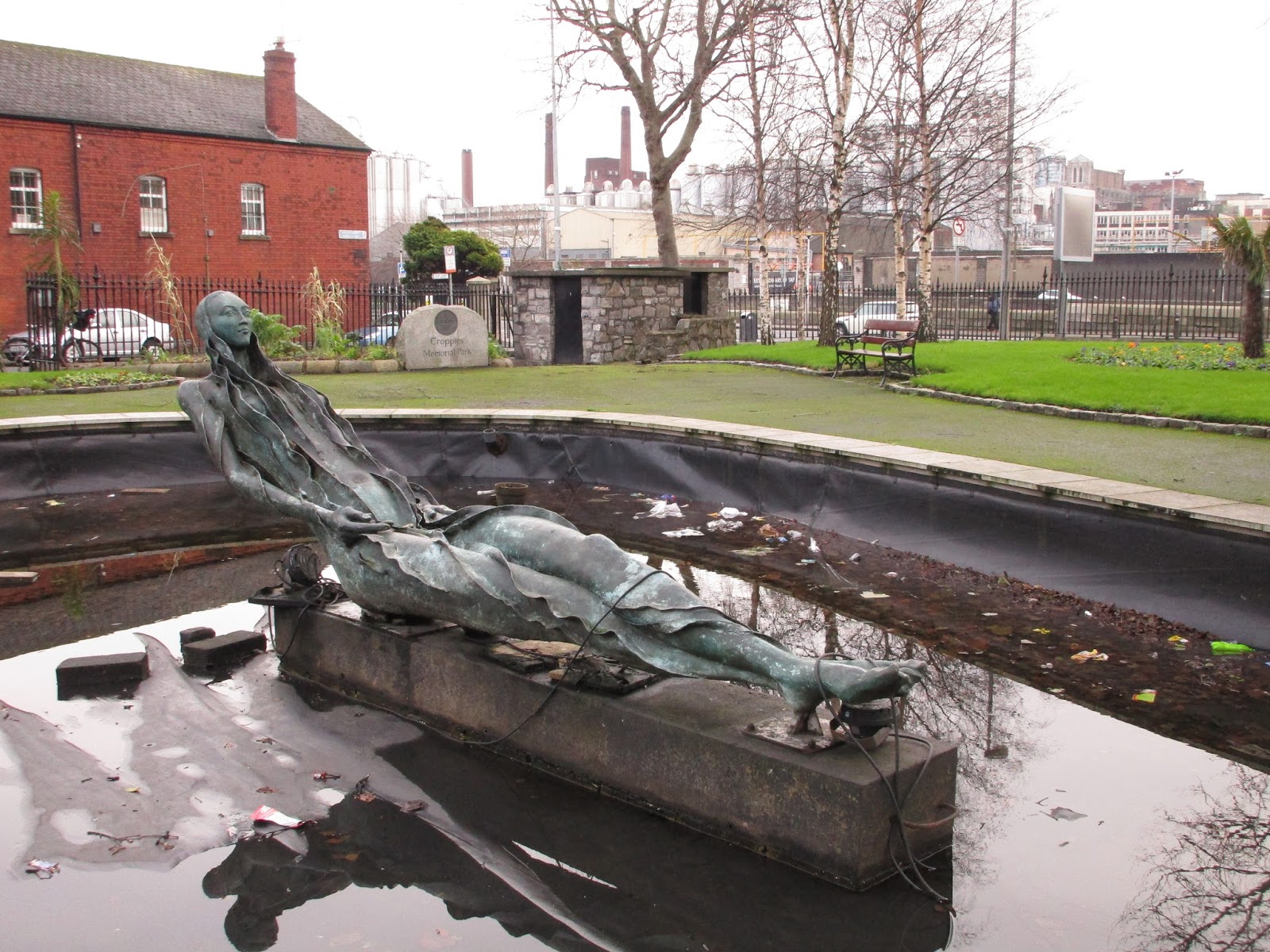
The interesting lady in the pond is officially known as Anna Livia. To learn a little about her history – including some of her more colorful monikers, read this link to Lisa Cassidy´s website Builtdublin: http://builtdublin.com/anna-livia-croppies-acre-memorial-park-wolfe-tone-quay-dublin-7/

FYI:   Builtdublin is one of my very favorite websites in the whole world, yes, in the whole world. Ms. Cassidy an architect created this site about hidden gems of Dublin architecture. The website is clearly a labor of love. And a joy to visit.

-  And that robot. Cool or what. The photo was taken at the BT School Science Exhibition in the RDS. – Not built by a student however!


And down the country.

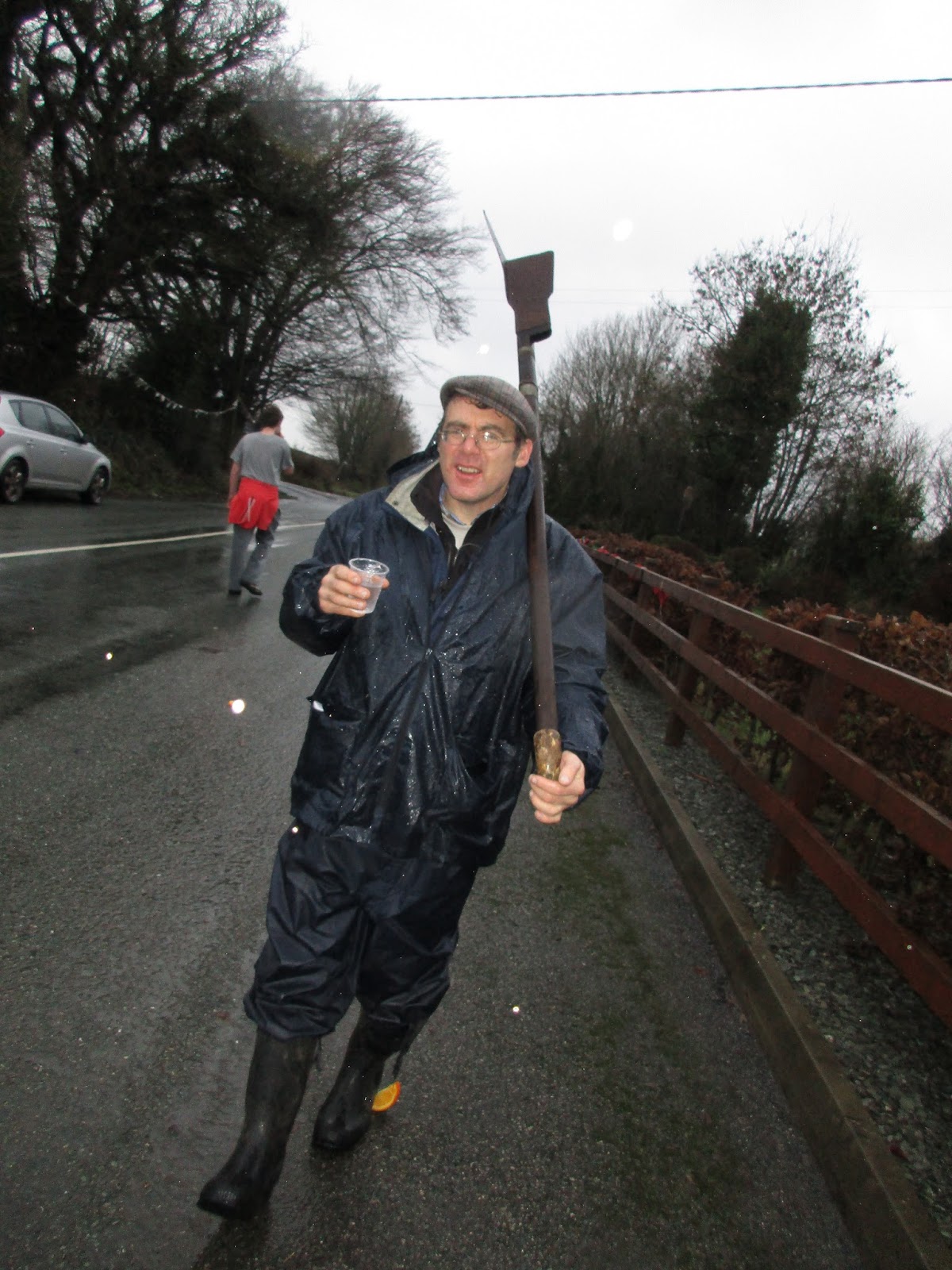
The Castlecomer Wellie Racing takes place on January 1st. This was the 36th such wellie race in that neck of the woods in Co. Kilkenny.

In the process of wearing (less than) fancy dress,that could prove to be a major regret in the years to come, and simultaneously getting soaked and sweaty running up and down hills in their wellies over the last 36 years – the race participants have raised ´mill´ens´ for charity.